Crypto Exchanges Without KYC
Best options for no-KYC trading, with Hyperliquid as the default for active perp traders
Best no-KYC setup for active traders
Core path (5-10 min)

Understand no-KYC exchanges

Use Hyperliquid (default choice)

Start trading (Quick Start)
Most traders switching from CEXs choose Hyperliquid for the same experience without KYC.
Step-by-step setup: wallet, bridge, first position.
Already familiar with trading?Open Hyperliquid directly
If you have traded on Binance, Coinbase, or Kraken, you know the drill: upload your passport, wait for approval, submit proof of address, maybe shoot a selfie video. Then, months later, an email arrives asking you to re-verify or face a withdrawal freeze. Plenty of traders are done with that dance - and the good news is you do not have to keep doing it.
This guide runs through the best crypto exchanges that let you trade without KYC - and helps you choose the one most traders actually switch to.

Why traders are leaving KYC exchanges
The usual reasons: privacy, speed, and control. KYC exchanges hold your funds in their custody - which means they can freeze withdrawals, close accounts without notice, block you based on your IP, or get hacked and lose your money.
You have also probably noticed that the list of no-KYC CEXs keeps shrinking. KuCoin, OKX, Bybit, and Kraken have all introduced mandatory verification over the last couple of years, and it is pushing serious traders toward decentralized exchanges (DEXs), where there is nothing to verify because there is no account to begin with.
What you'll find in this guide

Ranked and explained for real use cases

Why it's the default for active traders

Which model fits which trader

Essential things most people miss

The setup most traders end up using

Get from zero to first trade
Hyperliquid - the closest Binance alternative (without KYC)
If you are coming from a centralized exchange and want the same experience without KYC, this is where most traders switch.
Hyperliquid is the default pick for anyone who wants a centralized-exchange trading experience without the centralized-exchange overhead. It runs on its own layer-1 blockchain, offers a fully on-chain order book, executes trades in under a second, and supports 180+ perpetual markets with up to 50x leverage.
First trade in ~15 minutes, no KYC

For most traders, you don't need to compare further - this already covers everything a centralized exchange does, without the downsides.
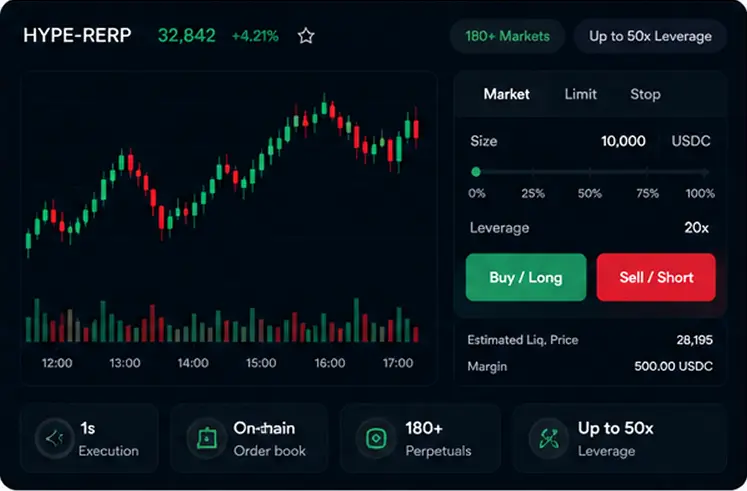


You connect a wallet and trade. That is the entire onboarding flow.
Hyperliquid cannot freeze your balance or block your withdrawal - it is structurally incapable of doing either.

The frontend is accessible from the US, UK, EU, Asia - everywhere there is internet.

Perps run 0.015% maker / 0.045% taker at the base tier, cheaper than Binance Futures.

Limit orders, market orders, stops, TradingView charts, leaderboards - if you have used a CEX, you already know how to use Hyperliquid.
It captured over 70% of DEX perps volume in 2025 for good reason. For most traders moving off a CEX, this is the default platform they end up using.
Other no-KYC options (only for specific use cases)
If you just want a full trading experience without KYC, you don't need these - Hyperliquid already covers that.
These platforms are useful in specific scenarios, but most traders do not use them as a primary venue.

On-chain perps pioneer since 2017. Now on its own Cosmos-based chain. 35+ markets, up to 20x leverage, no KYC, fully non-custodial.
Trade-offs: fewer markets than Hyperliquid, shallower liquidity on smaller pairs, and blocks US & Canadian users.

Uses a shared liquidity pool (GLP) instead of an order book. Zero price impact, up to 100x leverage, and no KYC.
Downside: fees and funding behave differently than traditional perps. Better suited for specific strategies rather than general trading.

Connect a wallet, pick two tokens, execute. Largest DEX by volume with $3B+ in liquidity. Never asks for ID.
No perpetuals, no leverage, and gas fees on Ethereum mainnet can sting. Use an L2 like Arbitrum or Base.

Same idea as Uniswap, but native to BNB Chain. Cheap transactions (often < $0.10), tons of altcoins and memecoins, built-in perps section, and no KYC ever.
Primarily used for token access, not active trading.

Operates without mandatory KYC in most regions (for now). Unverified accounts get generous daily withdrawal limits. 1,500+ cryptocurrencies across spot, futures, and copy trading.
Centralized - it still holds your funds. Can introduce KYC at any time (many former no-KYC CEXs have).

Similar to MEXC but leans more toward derivatives. Up to 150x leverage, 400+ assets, copy trading and bots included. Generous withdrawal limits before KYC kicks in.
Same caveat: centralized custody, so treat it as a tool rather than a primary platform.
DEX vs. no-KYC CEX: which should you pick?
If you are serious about escaping the KYC system - go DEX.
A "no-KYC CEX" is still a CEX. They can flip the switch overnight, and most eventually do. Decentralized exchanges cannot - because there is no identity layer to add.
Use DEXs for trading and swaps.
Use no-KYC CEX only for fiat rails or conversion.
Hyperliquid
The default choice for active perp traders
- No KYC, no account
- Non-custodial
- Deep liquidity
- CEX-like performance
- Advanced order types
Best for routing across pairs and accessing long-tail tokens.

Simple swaps, deep liquidity, no KYC.

Use only when you need conversion between fiat and crypto.
For conversion only, move funds out immediately.
What to know before you switch
Before you start, a few important things to understand:

Lose your seed phrase, lose your funds. Nobody can reset a password that does not exist.

No-KYC trading is private, not invisible - you are still required to report trades in most jurisdictions.
Phishing clones of popular DEXs are everywhere. Always navigate from a bookmark.
First trades on any new platform should be an amount you would be okay losing to a mistake.